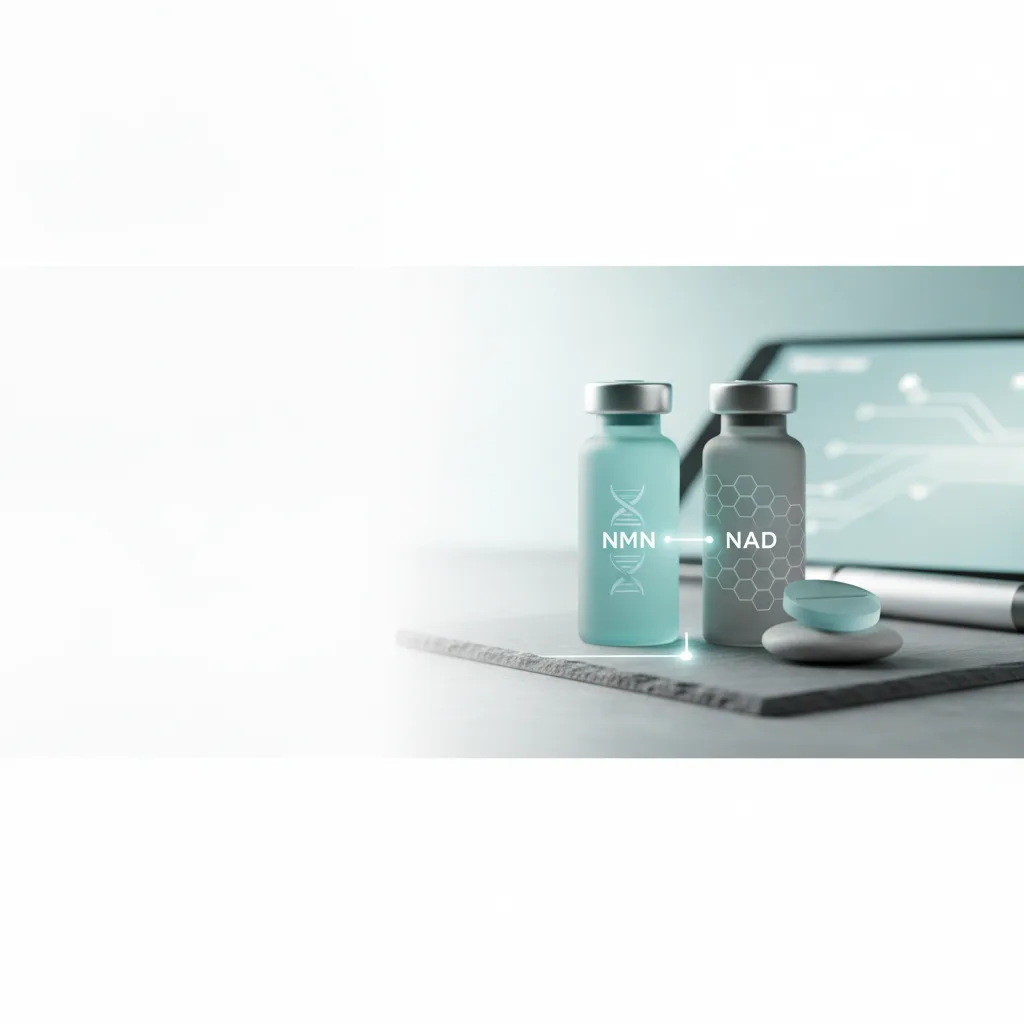
NMN vs NAD is a comparison between a precursor and the molecule it helps the body make. NMN means nicotinamide mononucleotide. NAD+ means nicotinamide adenine dinucleotide, a coenzyme. Neither name tells you whether a product improves how you feel. The route, formulation, human evidence and buying terms matter separately. Sources: NIH PubChem and the Yoshino NMN trial, 2021, reviewed 17 October 2026.
If you searched “NAD vs NMN” or “NMN and NAD,” the practical first step is to identify the actual product. A bottle of an oral precursor, a product labeled oral NAD+, a nasal spray and a prescription injection are different offers. A claim about one should not be transferred to the others. Our NAD injection hub covers clinic plans; this page explains the comparison that comes before choosing one.
What is the difference in NMN vs NAD?
NAD+ is the molecule named in the PubChem chemical record. NMN is a precursor used in NAD+ biosynthesis, as described in the 2021 Yoshino study. That relationship explains why the names appear together. It does not make a finished NMN supplement identical to NAD+ or establish that a particular brand is effective.
A useful product comparison has separate columns for ingredient and route. Without those columns, a seller can describe a study of an oral precursor while offering a different preparation. That leaves you comparing an advertised result rather than the thing in the package. Check the ingredient panel or prescription label first, then read the evidence attached to that formulation.
| Question | NMN | NAD+ |
|---|---|---|
| What is the molecule? | Nicotinamide mononucleotide, a precursor | Nicotinamide adenine dinucleotide, a coenzyme |
| What must you identify next? | Finished product, ingredients and oral formulation | Finished product and whether it is oral, nasal, injectable or an IV service |
| What evidence should match? | Human research on the actual ingredient and route | Human research on the actual ingredient and route |
| What does the name alone establish? | Chemical identity, not a health outcome | Chemical identity, not a health outcome |
The molecular definitions above come from PubChem and Yoshino. The remaining rows are our comparison criteria, not claims that either route is superior. “Direct NAD” may sound more efficient than a precursor, but a shorter description of a pathway is not a clinical result. For a purchase decision, ask the seller for the study that connects the actual product to the outcome being promised.
What does human evidence show about NMN and NAD?
The 2021 randomized Yoshino trial studied NMN in postmenopausal women with prediabetes and overweight or obesity. It found improved muscle insulin sensitivity. That specific finding does not establish lifespan extension, benefits for every healthy adult, or superiority to injected NAD+. Those are different questions from the one the trial answered.
For NAD+ itself, the Grant pilot published in September 2019 followed plasma and urine metabolites during an IV infusion. Its purpose was to examine metabolism. It was not a head-to-head trial against NMN, and it does not show that a home shot improves memory, reverses aging or treats persistent fatigue.
Our reading of these studies is that they do not resolve NMN vs NAD as a universal treatment contest. They differ in population, route and endpoints. A clinical outcome in one study cannot be ranked against a metabolism measurement in another as though both were the same test. The defensible conclusion is narrower than either product category's advertising often suggests.
If you are considering clinic care after reading the comparison, read our Willow review for a concrete example of the questions to ask about the treatment, pharmacy and recurring payment. A clinic review assesses the service's published terms. It does not establish that its treatment is medically appropriate for you.
Which routes belong in an NMN vs NAD comparison?
No comparison should assume that they are. “NAD” can describe an ingredient, a product category or an informal name for a service. Keep those meanings separate when you read an offer. Ask whether the treatment is an injection sent to your home, an infusion administered at a clinic, a nasal product or a supplement, and ask which evidence applies to that route.
The Grant study above concerns IV administration. It should not be used as instructions for a subcutaneous product. Likewise, the Yoshino finding concerns oral NMN, not a claim about the contents or quality of every product with NMN on its label. A route-specific result needs a route-specific interpretation. Our NAD injection side-effects guide explains why that distinction also matters when discussing tolerability.
The FDA has a separate concern about injectable preparations. Its sterile-compounding notice, reviewed 17 October 2026, describes adverse events following NAD+ injectables and warns about unsuitable food-grade ingredients and potential endotoxin contamination. Manufacturing and pharmacy questions therefore belong in the comparison alongside clinical evidence.
For NMN vs NAD, this means ingredient choice and product quality are two different decisions. Even if a study supports a particular biological effect, you still need to know what the seller supplies. Conversely, a detailed product label cannot answer whether the treatment produces an outcome the study never tested. Neither kind of evidence replaces the other.
How should you compare NMN vs NAD costs and plan lengths?
Compare what you must pay for the actual package or service, rather than treating every number beside a dollar sign as a comparable monthly price. A bottle price, a recurring subscription, a prepaid supply and an introductory charge answer different questions. Start by writing down the charge, what is included and the commitment attached to it.
A live clinic example illustrates the distinction. Willow's NAD+ page, read 17 October 2026, advertises $199/mo. Its terms, read the same day, describe a monthly subscription charged until cancellation, with the applicable billing interval disclosed at enrollment. The product page does not establish the precise vial strength or a fixed supply duration. Confirm those details before comparing it with another offer.
| Buying question | What to record |
|---|---|
| What leaves your account first? | The checkout total, including any disclosed separate charges |
| What repeats? | The recurring amount and billing interval |
| What does the payment cover? | The named product, package or prescribed supply |
| What commitment applies? | Subscription, prepaid term or one-time purchase |
| What remains unclear? | Missing renewal amount, supply length or cancellation terms |
| When was it checked? | The date the price and its conditions were read |
This is a framework for comparing offers, not a list of fees Willow necessarily charges. If a fee is not published, record it as unknown rather than free. If a product's supply length is not stated, record that uncertainty rather than assume a month because the advertisement uses “per month.”
The NMN vs NAD price question is therefore not just whether a powder costs less than a clinic. It is whether you are comparing the same purchasing unit and whether the additional service is something you actually want. Our supplement versus clinic comparison examines that separate service question. Our clinic price disclosures show the distinctions used in our reviews.
We do not calculate a supplement-versus-injection value score by dividing two advertised amounts. Such a score would imply a relationship between the products' benefits that the evidence above does not establish. A lower charge is a fact about a transaction. Better value for a health outcome requires evidence about that outcome as well as the cost.
How can you judge claims without treating marketing as evidence?
Use three questions: what was measured, in whom, and with which formulation? A seller's answer should point to the actual human study. A paper showing a change in a blood marker answers a different question from a paper measuring symptoms, physical function or disease outcomes. Keep the outcome named rather than replace it with a broad phrase such as “works.”
Then read the comparison being made. “Compared with placebo” is different from “compared with NMN,” and an uncontrolled before-and-after observation is different from a randomized comparison. If no head-to-head test is supplied, do not invent a winner from separate studies. These are our evidence-reading criteria; they are not a claim that all research uses one design or that only one design can be informative.
The source should also identify the product tested. A trial on an ingredient does not automatically validate a proprietary blend, delivery claim or branded formulation that adds other ingredients. Ask the seller to distinguish ingredient research from research on its finished product. If it cannot, treat the missing link as a limitation of the claim, not as proof the product must fail.
For NMN vs NAD, a useful answer can remain conditional. For example, the evidence may address one marker in one population while leaving your own goal unanswered. That is a reason to avoid a broad promise. It is not a reason to fill the gap with testimonials, a biological diagram or a higher advertised strength.
The FDA's supplement questions and answers, reviewed 17 October 2026, explains that supplements are not approved before marketing and advises discussion with a health professional before use. A reference to registration or notification should not be read as approval of a personal health benefit.
Should you combine NMN and NAD or choose a dose from a study?
This page does not recommend combining products, choosing a dose or copying an injection schedule. The studies cited do not establish a combined regimen for you. Show a clinician or pharmacist the complete labels and prescription details, including other medicines and supplements you use, before deciding whether either product belongs in your care.
A comparison page should not turn an unanswered research question into a treatment plan. If you are looking at multiple products, list their ingredients rather than relying on the names on the front of the packages. That makes it easier to discuss what overlaps and what each seller is asking you to buy. The relevant advice is specific to your situation, not a general instruction to stack NAD-related ingredients.
NMN vs NAD also cannot diagnose why you feel tired, have trouble concentrating or are worried about aging. If a symptom is the reason for considering a purchase, bring the symptom to the clinician rather than assume a product category has already identified its cause. The aim of the comparison is to make the purchase and evidence clearer, not to replace an assessment.
What information should be in your comparison notes?
Keep a short record for each offer. Include the exact product name, ingredient, route, seller, label or prescription details, current checkout terms, source URL and the day you read it. For an injectable, add the dispensing pharmacy and the person responsible for answering questions. For a supplement, add the lot information and whatever product-specific testing documentation the seller supplies.
Separate direct observations from interpretations. “The page lists a monthly subscription” is a different statement from “this is the cheapest way to achieve my goal.” “The trial measured this marker” is a different statement from “this product will improve my energy.” Writing those statements separately makes the uncertain part visible before you commit to recurring payments.
A simple uncertainty column is useful. Mark missing details as questions for the seller rather than quietly choosing the most favorable answer. An incomplete offer might become comparable after the seller explains it. If it does not, the missing information remains part of the decision. Our editorial policy explains why published terms and source dates matter in the clinic reviews.
You can also record what would change your decision. Perhaps the barrier is an unclear renewal charge, a formulation that does not match the cited research, or a benefit claim that lacks an appropriate human outcome. Naming that barrier helps keep a sales conversation focused. More testimonials do not answer a billing question, and a cheaper subscription does not answer an evidence question.
When returning to the same offer later, check the current package and terms again. Keep an older source date attached to an older observation. That prevents a saved screenshot or comparison from looking like a fresh verification. The Willow example here is dated 17 October 2026; its source links are provided so you can check the offer you actually see.
Does a more expensive offer settle the NMN vs NAD question?
Price alone cannot settle it. A seller may be offering a different package, a recurring service or a particular formulation. Those differences need to be described rather than converted into an assumption about a stronger health benefit. Ask what explains the charge and whether that explanation addresses your own reason for comparing the products. If the answer concerns convenience while your question concerns clinical evidence, the two questions remain separate.
What if two sellers cite the same research?
Read how each uses the citation. One may accurately describe the measured outcome while another extends it to a broader claim. The paper itself has not changed. Compare the advertised conclusion with the study's actual question, population and route, and ask each seller to explain the connection to its finished product. This is our reading method, not a new finding from the trial. It also gives you a useful way to revisit the comparison later: save the claim alongside the citation, rather than keeping only the reference list. A long list of papers can look reassuring while leaving the central product-specific question unanswered.
Which pages should you read next?
For NMN vs NAD, start with the distinction between molecule, route and outcome. Then use the page that matches your next question:
- NAD injections: treatment-specific clinic prices, plan terms and evidence questions.
- NMN vs NR cost per gram: a different comparison between two precursors, with dated product observations.
- NAD supplements versus clinic care: what the service comparison is asking you to buy.
- Willow review: one clinic's published offer and the limitations we recorded.
Our pick for the next step is a clearer comparison, not an automatic purchase. Identify the ingredient and route, check the evidence against the claim and confirm the payment commitment. If those answers do not match your goal, there is no need to force a winner between two product labels.
Sources and product terms reviewed 17 October 2026. This article is information, not medical advice, and does not provide doses or administration instructions. Clinic reviews may contain affiliate links; those relationships do not determine our scores or the evidence conclusions above.